- Thermal Oil Boiler vs Steam Boiler: Which Is Better for Your Business in
- New hot water equipment ready to be shipped
- Thermal Oil Boiler Selection: Complete Guide
- 6-Ton Biomass-Fired Chain Grate Steam Boiler Shipped to Benin
- 15ton coal fired boiler was delivered to Sri Lanka
contact person:Mr. Liu
cell phone:16649875575
Telephone-WhatsApp:+86 16649875575
email:1776172737@qq.com
address:Hot Feng Boiler, Taikang County, Henan Province, China
Thermal Oil Boiler Selection: Complete Guide
What Is a Thermal Oil Boiler?
A thermal oil boiler (also called a heat transfer fluid boiler or hot oil heater) is a closed-loop heating system using synthetic or mineral thermal oil
as the heat carrier. Unlike steam boilers relying on water and pressure, it heats oil to 200–350°C at near-atmospheric pressure.
The oil circulates through pipes and heat exchangers to transfer heat to equipment, then returns to the boiler for reheating.
This closed loop ensures high efficiency and safety. Designed for continuous, precise temperature control, it avoids water treatment, scale buildup,
and high-pressure risks. Most models are easy to operate, even for teams with limited technical experience.
Main Industries Using Thermal Oil Boilers
Thermal oil systems suit any industry needing consistent medium-to-high temperature heating. Common sectors:
- Chemical & Petrochemical: Resin, synthetic fiber, rubber, coating, adhesive production
- Textile & Dyeing: Drying, setting, dyeing, finishing processes
- Food & Beverage: Cooking, frying, baking, chocolate melting, syrup heating
- Plywood & Wood Processing: Hot pressing, veneer drying, laminate production
- Paper & Packaging: Paper drying, ink drying, carton forming
- Plastics & Rubber: Extrusion, molding, calendering, vulcanization
- Asphalt & Road Construction: Asphalt heating and insulation
- Pharmaceuticals: Reaction kettles, drying ovens, purification processes
Any factory needing stable heat above 150°C and avoiding high pressure benefits from it.
Key Features & Advantages
Why factories switch to thermal oil, based on real customer feedback:
1. Low Pressure, High Safety: 300+°C at near atmospheric pressure (steam needs 10–15 bar). Fewer risks, simpler piping, lower costs—ideal for old factories or limited safety infrastructure.
2. Excellent Temperature Control: Holds ±1–3°C, critical for chemicals, plastics, food, textiles (avoids product waste). Food factories report better consistency post-switch.
3. High Thermal Efficiency: Closed-loop minimizes heat loss (85–95% efficiency), lower fuel bills than open steam systems.
4. No Water Treatment Hassle: Skips softeners, deaerators, chemical dosing. Oil resists mild cold freezing, good for temperate regions.
Which Factories Benefit Most?
Plants seeing the biggest improvements:
- Need stable 200–350°C heating
- Can’t risk high pressure (old buildings, tight spaces)
- Poor water quality (hard water, limited treatment access)
- Temperature-sensitive production (chemicals, food, pharmaceuticals)
- Aim to cut operating costs (fuel, maintenance, water treatment)
- Remote/off-grid sites (biomass/diesel models work best)
- Upgrading from costly old steam systems
It often pays for itself in 1–2 years if you struggle with overheating, uneven drying, or high water bills.
Why Fouling & Scaling Occur
Fouling reduces efficiency, raises fuel use, and damages equipment. Main causes (from our experience):
1. Thermal Cracking & Oxidation: Overheating or prolonged high temp breaks down oil, forming carbon deposits—most common with poor operation.
2. Poor/Contaminated Oil: Cheap oil degrades fast. Mixing types or letting dirt/water enter causes rapid fouling. Use supplier-recommended oil.
3. Incorrect Operation: Overheating, low flow, frequent on/off, ignoring alarms. Operator training is key.
4. Lack of Maintenance: Skipping oil tests (3–6 months), filter changes, flushing lets deposits build.
5. System Design Issues: Poor circulation, dead zones, undersized pumps create hot spots. Work with experienced suppliers.
Fouling signs: Higher fuel use, lower outlet temp, pressure increase, frequent overheating, slower heating. Fix with quality oil, proper operation, and maintenance.
Fuel Types: Which Is Best?
Four common fuel options, based on thousands of orders:
1. Oil & Gas
Fuel: Diesel, heavy oil, natural gas, LPG
Best for: Stable fuel regions, clean/automatic needs
Pros: High efficiency, low labor, clean combustion, quick temp adjustment
Cons: High fuel cost, needs storage/pipeline, price swings
Popular: Urban areas, MENA (abundant gas)
2. Biomass Fired
Fuel: Wood chips, sawdust, rice husk, bagasse, palm kernel shell
Best for: Wood/agricultural plants (own biomass waste)
Pros: Low fuel cost, renewable, carbon-friendly
Cons: Storage/feeding system, more ash, higher labor, moisture-dependent combustion
Popular: Southeast Asia (abundant palm shell/rice husk)
3. Electric Heating
Power: 380V/400V industrial electricity
Best for: Strict emissions, small-scale, clean workshops (pharma/electronics)
Pros: Zero pollution, precise control, simple installation, low maintenance
Cons: High operating cost (expensive power), not for large capacity, needs stable grid
4. Coal Fired (Less Common)
Used in remote areas but phased out for emissions. Most switch to gas/biomass/electricity.
- Previous:6-Ton Biomass-Fired Chain Grate Steam Boiler Shipped to Benin
- Next:New hot water equipment ready to be shipped
-
2026-06-19New hot water equipment ready to be shipped
-
2026-06-19Thermal Oil Boiler Selection: Complete Guide
-
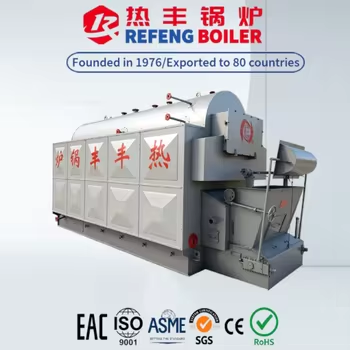
Паровой котел на биомассе DZL 18 тонн 1.6МПа для линии производства фанеры, промышленный, с тяжелой решеткой, стабильное тепловое снабжение
-
Паровой котел на биомассе DZL 16 тонн 1.6МПа для линии производства фанеры, промышленный, с тяжелой решеткой, стабильное тепловое снабжение
-
Паровой котел на биомассе DZL 15 тонн 1.6МПа для линии производства фанеры, промышленный, с тяжелой решеткой, стабильное тепловое снабжение
-
Паровой котел на биомассе DZL 12 тонн 1.6МПа для линии производства фанеры, промышленный, с тяжелой решеткой, стабильное тепловое снабжение
-
Паровой котел на биомассе DZL 10 тонн 1.6МПа для линии производства фанеры, промышленный, с тяжелой решеткой, стабильное тепловое снабжение
-
Паровой котел на биомассе DZL 8 тонн 1.6МПа для линии производства фанеры, промышленный, с тяжелой решеткой, стабильное тепловое снабжение